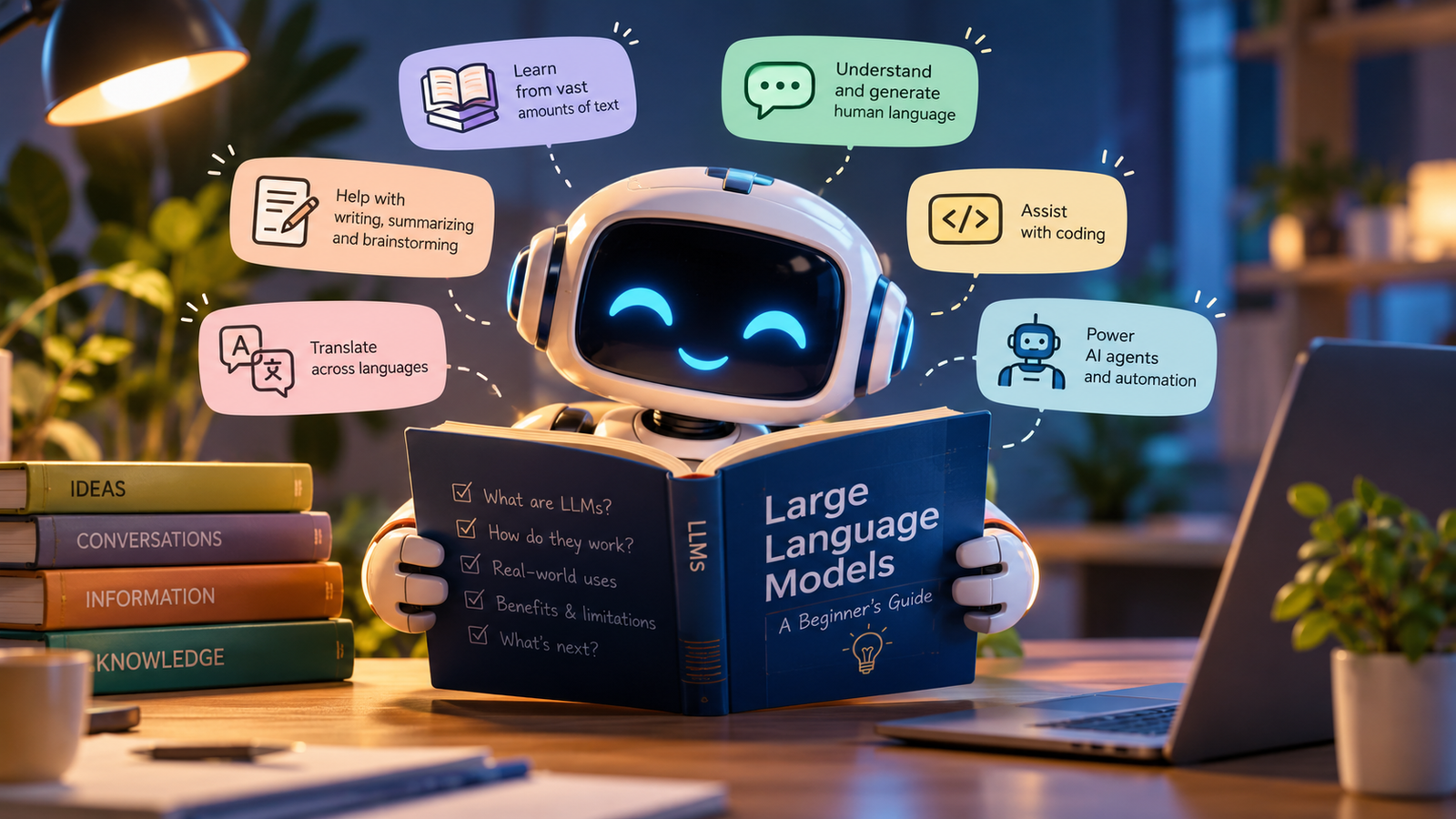
MEET LLMS: THE TECHNOLOGY BEHIND YOUR FAVOURITE AI TOOLS
You’re typing a WhatsApp message, and your phone suggests the next word. Handy, if a little predictable. Now imagine that same trick, trained on a vast amount of human writing, able to draft emails, explain contracts, and help write code. That’s a large language model, and it’s far less mysterious than it sounds.
What Is a Large Language Model?
A large language model, or LLM, is a computer program that has learned how language works by studying huge amounts of text. It uses deep learning, a branch of AI in which layers of artificial “neurons” learn patterns from examples rather than follow hand-written rules. Its core skill is simple: predicting what comes next. The model reads text in small chunks called tokens (a whole word or just a piece of one). Your phone guesses one word at a time, while an LLM chains its guesses together into full paragraphs, answers, and reports. Tools like ChatGPT and Claude are everyday examples.

How LLMs Are Trained
Picture someone who has read a library the size of a city. They haven’t memorised every page, but they’ve absorbed patterns: how a complaint letter sounds, how a recipe is laid out, how a polite refusal is phrased.
Training works like a giant guessing game. The program hides the next token in a sentence, guesses, checks the answer, and adjusts. Because the text itself supplies the answers, nobody has to label anything by hand. This approach is called self-supervised machine learning, and it is why models can learn from such vast amounts of writing. Their internal settings, called parameters (think of them as millions of tiny dials), get nudged slightly each time. Repeat that an enormous number of times, and the model becomes remarkably fluent.
Transformers and Self-Attention
The design behind modern LLMs is called a transformer. Its secret ingredient is self-attention, which is a fancy way of saying the model weighs which words in a sentence matter to each other.
Take this line: “I put the cake in the box, but it was too big.” You instantly know “it” means the cake, because you connect the right words without thinking. Self-attention lets the model do something similar across whole paragraphs, keeping track of who and what is being discussed, even when the clues sit far apart.
Fine-Tuning and Human Feedback
A freshly trained model is like a smart graduate on day one: knowledgeable, but not yet good at the actual job. Fine-tuning is the specialised training that follows. A bank might train a model on its own support conversations so it speaks the bank’s language.
Then comes human feedback. In a method called RLHF (reinforcement learning from human feedback), people review the model’s answers and rank which ones are clearer, safer, and more useful, much like a manager reviewing a new hire’s work. The model is rewarded for producing answers people prefer, so over time it learns what a good answer looks like.
Prompt Engineering and AI Reasoning
Tell a taxi driver “take me somewhere nice,” and you’ll get a surprise. Say “Terminal 2, via the highway, I’m in a hurry,” and you’ll get what you need. Prompts work the same way. The instructions you give an LLM, called a prompt, shape the quality of what comes back. Writing them well is called prompt engineering, and it mostly comes down to clear context, a defined role, and a requested format.
Reasoning follows a similar logic. Ask the model to work step by step, like showing your working in a maths exam, and it tends to handle multi-part problems more reliably.
 Real-World Applications of LLMs
You may already be using LLMs without noticing. Customer support chat assistants answer routine questions at any hour. Writing tools draft and polish emails. Summarisation turns a 40-page report into a one-page brief. Developers use them to write and debug code, while translation tools help teams communicate across languages. Students use them as patient tutors that explain a concept five different ways until it clicks.
AI Agents and Automation
A friend who suggests flights is different from an assistant who actually books them. An AI agent is an LLM connected to tools, such as your calendar, email, or company database, so it can plan steps and carry them out.
Imagine an agent that reads incoming invoices, flags anything unusual, drafts a reply, and updates your records, with a person approving the important decisions. That’s automation with a human still in charge.
Limitations, Safety, and Evaluation
LLMs are like a very confident friend who occasionally gets facts wrong. The industry calls this hallucination: the model produces something that sounds right but isn’t. They can also reflect biases from the text they learned from, and their knowledge may be out of date.
That’s why safety matters. Guardrails limit harmful outputs, sensitive data needs careful handling, and high-stakes decisions should always involve human review. Evaluation is how we check quality. Much like testing students, models face exams, spot checks, and real-world trial runs before anyone trusts them with important work.
The Takeaway
LLMs aren’t magic, and they aren’t a threat to be feared. They’re powerful tools that work best when people guide them clearly and double-check what matters. Used well, they can save hours of routine work and free teams to focus on judgment and creativity.
Large Language Models are changing how people write, learn, communicate, and manage everyday tasks. You don’t need technical expertise to start exploring them. Begin with a simple question, experiment with different instructions, and discover where AI can genuinely save you time.
Curious about using AI in your business?
Connect with LeadPro Infotech to explore practical AI solutions that suit your business needs and help your team work more efficiently.